
In Stage 2 (Stirrings), consciousness expands as an understanding that previously was dormant and unrecognized begins to percolate up to the surface. A tension arises between the impulses of these new, inner stirrings the grip of the established order set up in Stage 1.
Buddhism
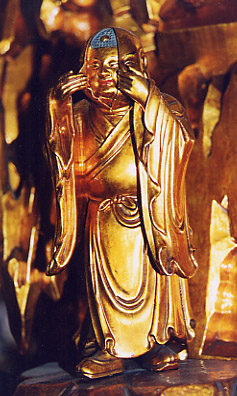
The Hebrews of the Old Testament saw God as an all-powerful, omniscient Dad figure. In this next phase, arising in human consciousness was the idea that the divine could be consciously realized within.
In 563 B.C., Siddhartha Gautama was born into a royal family in the foothills of the Himalayas. His personal development followed the same stages we’ve seen over and over again. After leaving behind his birthplace (and everything having to do with his personality or false self), he awakened under the Boddhi Tree and became known as The Buddha. The Buddha went on to teach for the rest of his life, embodying for humanity the possibility that we do and can attain enlightenment. We can know the Divine directly. The Buddha outlined the Four Noble Truths and the Eightfold Noble Path pointing the way to freedom from suffering and attachment and the arrival at nirvana – indwelling peace that comes from the extinction of desire.
Confucianism
 Born at about the same time (551 B.C.) in China came Confucius who would bring to humankind, within the understanding of our evolutionary stages, a countering impulse. (Remember, Stage 2 is filled with tension – the new human possibility arising amid laws that attempt to resist and reinforce the status quo.)
Confucius was born at the time period leading into the Era of Warring States – an epoch of huge upheaval and social anarchy. The social codes holding civilized life together were breaking down, for the Chinese people of the day (primarily Hindus who had been at the evolutionary process the longest) were becoming too independently minded (note the pattern and its impulse towards individuation).
Responding to the need for a stronger social order and what he perceived to be a divine calling, Confucius taught a system of deliberate tradition. Confucianism, as it came to be called, outlined five main tenets for cohesive social life, many of them rooted in correct relationships with family and authorities (parents, elders, husbands and rulers). (You can see the roots of Stage 1 trying to reassert themselves.) Confucianism became the central constant around which Chinese civilization flourished for sixteen centuries to follow.
Taoism
 Consistent with our pattern, however, the rumblings ushering in the next state of consciousness persist. Born also at around that time (historians differ, but believe it was around the 6th to 4th century B.C.), was Lao Tzu, the founder of Taoism (pronounced “Dow-ism”). Like the Buddha, Lao Tzu awoke to universal consciousness (non-duality) and, not surprisingly, rejected Confucianism as being too controlling. He was leaving civilized life to go live as a hermit when he was asked to write down what he knew. He penned a slim but potent volume, the Tao Te Ching (“Dow Dee Ching”) which loosely translates to “The Way and Its Power.”
In his book, the Tao (“path” or “way”) takes on several different meanings. It is simulanteously True Reality (what you see when the paper bag of the false self is pierced), the way that True Reality operates, and the way of human life naturally ushers each of us to the Tao. Lao Tzu saw no difference among any of these definitions.
The Tao Te Ching instructs the reader on how to align with Wu Wei, or supreme action (the way of the Tao). His sayings in the Tao Te Ching are literal articulations of non-dual consciousness. To Lao Tzu, the highest human attainment is to identify oneself with the Tao and let It work through you.
So in sum, in Stage 2, you have two religious impulses brought to earth by two awakened masters who not only declare but embody the notion that peace is within and that it’s a mind-set. Then you’ve got Confucious resisting, trying to reassert the Law to keep society on an even course. As we shall see, both impulses are necessary to keeping the overall evolutionary process humming, and both are consistent with the Stage 2 (“Stirrings”) of human conscious development.
 Level Praying Field