
At the Overview stage, a basic blueprint is laid out for the developmental tasks to come. Hinduism, the world’s oldest religion, and the teachings of the first prophet Abraham (considered the father of Judaism, Christianity and Islam) provided that overview.
Hinduism (5000 B.C. forward)
The world’s earliest sacred teachings were Hindu, dated to approximately 5000 B.C. They were passed down orally until they were written down beginning in about 1500 B.C.
The Vedas were the earliest Hindu scriptures. The Vedas described an ever-present God who took many forms. They also offered detailed practices, called yogas, for accomplishing the basic objective of life: to attain conscious reunion with the Divine.
Many Hindu scriptures came after the Vedas. In these texts, God began to be understood as having both many parts and as being a unified, divine All, called Brahman.
Brahman was understood to have three parts, or expressions, in three the form of three different dieties:
- Brahma, who creates the universe
- Vishnu, who preserves the universe
- Shiva, who destroys the universe
The Upanishads (900 B.C.) describe an indwelling atman within each human individual, each atman a spark of Brahman. (This atman is what gets perceived by mystics at Stage 3, “I Am.”)
The Bhagavad-Gita followed the Upanishad texts in the 5th-2nd centuries B.C. The Bhagavad-Gita is the story of Arjuna, a warrior, who receives instruction from Krishna (the Preserver manifestation of the Divine, always depicted blue) as Arjuna prepares to enter battle.
This “battle” is a thinly veiled allegory for incarnate life on earth. Krishna’s instruction is essentially a primer on how Arjuna can make his way through the “battlefield” of life and accomplish his objective: to evolve spiritually and reunite with the Divine.
The Bhagavad-Gita’s battlefield analogy is apt, for as we will see, one of the main constants of life on earth is the ongoing presence of conflict.
Abraham (2000 B.C.)
Meanwhile, in Mesopotamia (the other major civilization flourishing on earth at the time), Abraham brought an essential teaching of faith.
As Abraham grew spiritually, he was tested by God: how far would Abraham go in obedience to God’s Will? Would he go so far as to kill his beloved son Isaac if God asked? Here’s how the story is told in the Old Testament:
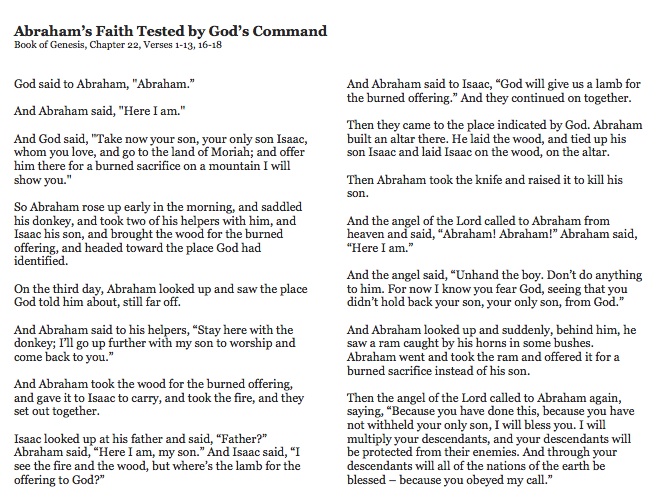
After passing this supreme test of faith, Abraham went on to become the first prophet and the father of Judaism, Christianity and Islam. He also established a special covenant relationship between God and the Jews which laid the foundation for humanity’s Stage 1.
 The story of Abraham and Isaac shows the most fundamental requisite of spiritual evolution: total and unquestioned faith. To evolve successfully, nothing can come before God, no matter how beloved other things may be to you. Not your spouse, your family, your career, home, money, ambitions… nothing. God must be the absolute, unquestioning center of your life; the frame of reference for all else.
The story of Abraham showed something else: that you follow God step by step. As you venture forward, you won’t know the outcome. You just follow, as if holding blind onto a thread, trusting that each next step will be made known to you and lead you rightly. Abraham didn’t know what would happen at the top of the mountain. In fact, it’s unclear in the story whether he, in fact, trusted God to help him find another lamb to offer, or he was just saving Isaac from the hard truth. But he went.
The world’s earliest religious teachings, then, gave humankind a basic Overview of the human spiritual journey:
- What’s the goal? Conscious reunion with the Divine
- What are its parts? Creation, Preservation, Destruction
- How do you get there? Yogas, discipline, practice, obedience
- What’s it like? A battlefield
- What’s required? Absolute, unconditional faith
View the next stage: Definition & Laws
Return to the World Religions page
 Level Praying Field