If you haven't yet read the "After Awakening" page, please do so before proceeding.
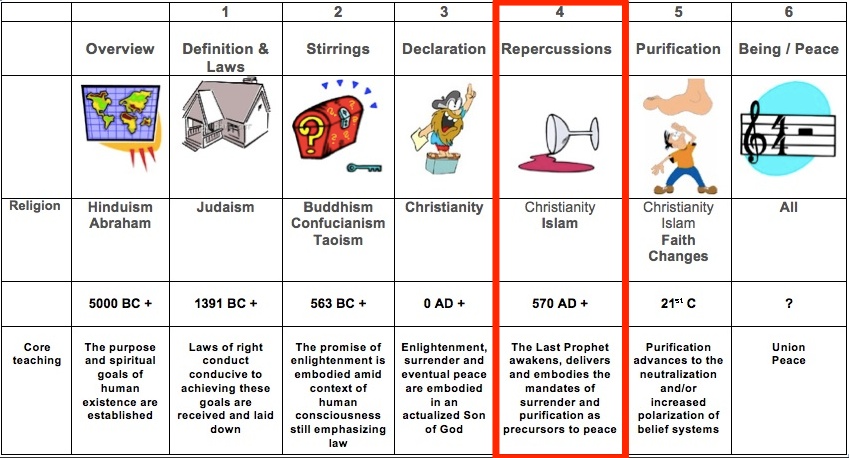
In Stage 4 (Repercussions), Stage 3’s Declaration of greater authenticity and consciousness yields consequences. The emotional commitment to the new way of being is tested.
Islam
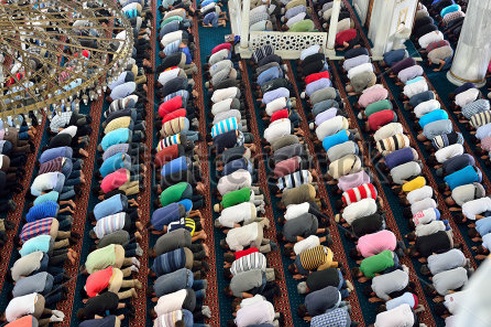 Both words Islam and Muslim derive from the root s-l-m which means wholeness, safety and peace.
The word Islam means “to submit” – but not in the sense of being vanquished; rather to willfully, totally commit. In a religious context, Islam means complete submission to the Will of God. The people who honor and observe Islam are Muslims.
Islam came to the world because of the life and clarity of the prophet Muhammed, born 570 C.E. in Mecca, now Saudi Arabia.
By all accounts, Muhammed was a very devout, upright man who survived a childhood of enormous tragedy (his father died before he was born, and his mother died when he was six) to become a camel driver, then a manager of caravans for local merchants. By the time he died, most of the Arabian peninsula had converted to Islam, uniting the people under a single faith. Today there are 1.6 billion Muslims in the world, making Islam the world’s second largest religion.
The Foundation of Islam: The Qu’ran
Muhammed did not set out to start a religion, nor did he propose or accept that he was the basis of any religion. Rather, his purity and clarity made him God’s chosen instrument to receive revelations from which Islam sprang.
In young adulthood, Muhammed developed the practice of retreating to a cave in Mt. Hira for periods of reflection and prayer. There, in 610 C.E. when he was 40 years old, he experienced his first “Night of Power”: a visitation from the Archangel Gabriel who commanded him, “Proclaim!” Muhammed dutifully transcribed the message, which he understood to be coming directly from God. This recitation became the first of many revelations given to him over the course of his life.
The Qu’ran is the composite book of these transmissions. It is considered by Muslims to be the perfect revelation of God’s Will. The Qu’ran is the foundation of Islam.
Unification – “There is no god but God!”
The primary message of the Qu’ran is to proclaim the unity, the almighty power, the omniscience and the mercy of God. The call to prayer – which joins all Muslims in prayer facing Mecca 5 times a day – features the words, “Allahu Akbar. Allahu Akbar. La ilaha illa’llah” which means “Allah is Most Great. Allah is Most Great. There is no god but God!”
 This religion has no compromise. There is only God. Thus it is a religion that proclaims universal consciousness: only one thing exists: God. Not “a God” or “our God” but The God. Not a world divided: God everywhere. God whole, all powerful, compassionate, merciful.
This understanding was a breakthrough and highly controversial in its time. Muhammed received the Qu’ran in an era when polytheism (the worship of multiple gods) was common. In the arc of developing consciousness of the world religions, it comes on the heels of Christ’s introduction of a triune God (Father, Son, Holy Ghost) – which Muhammed rejected (although Muhammed did acknowledge the authenticity of Jesus as a true messenger of God). So we see in the emerging consciousness brought to the world by Muhammed a unification where previously there were parts – which is consistent with the realization of Stage 3 and the repercussions of Stage 4, whose purpose is to sort out what’s what after the transition from dual to universal consciousness.
Consistent with a unified perspective, human nature is understood differently in Islam, too. While Islam shares with Judaism and Christianity a common father in the first prophet Abraham, unlike Judaism and Christianity, Islam does not perceive humankind as having suffered from original sin. Humans are seen by Muslims to be unquestionably, fundamentally good.
Nor does Islam see God seen as parental. To the Muslim, to think of God as a parent makes God too human, too diminished. God is far too powerful and all-encompassing for that. So clearly this is a consciousness that, on the level of world religions (but consistent with our Stage 4), has also fully individuated from childhood and made its declaration based on wholeness and individual authority.
Ghaflah – forgetfulness – and the task of staying faithful
While the Qu’ran holds that humankind is essentially, unquestionably good, the scriptures do acknowledge that humankind tends to drift and forget. The Qu’ran admonishes humankind not to fall victim to a spiritual lethargy (ghaflah) that forgets the correct obedient, totally committed relationship to Allah. The individual’s obedience, attention and devotion to God is reckoned in every moment and at the hour of judgment between the individual and God – with no intermediary. Either there is faithfulness, obedience and commitment or the person is an infidel – one who lacks gratitude to God and is not exhibiting the appropriate, committed and faithful relationship. Every gesture, every thought, every feeling by the individual matters and contributes either to the cultivation or erosion of their total commitment. But if when people do forget, they realize it and ask forgiveness, Allah is understood to be immediately forgiving and merciful. Indeed, each book in the Qu’ran begins with the phrase: “In the Name of God, the Compassionate, the Merciful.”
The Five Pillars of Islam
Muslims are required by the Qu’ran to observe the following elements of faith:
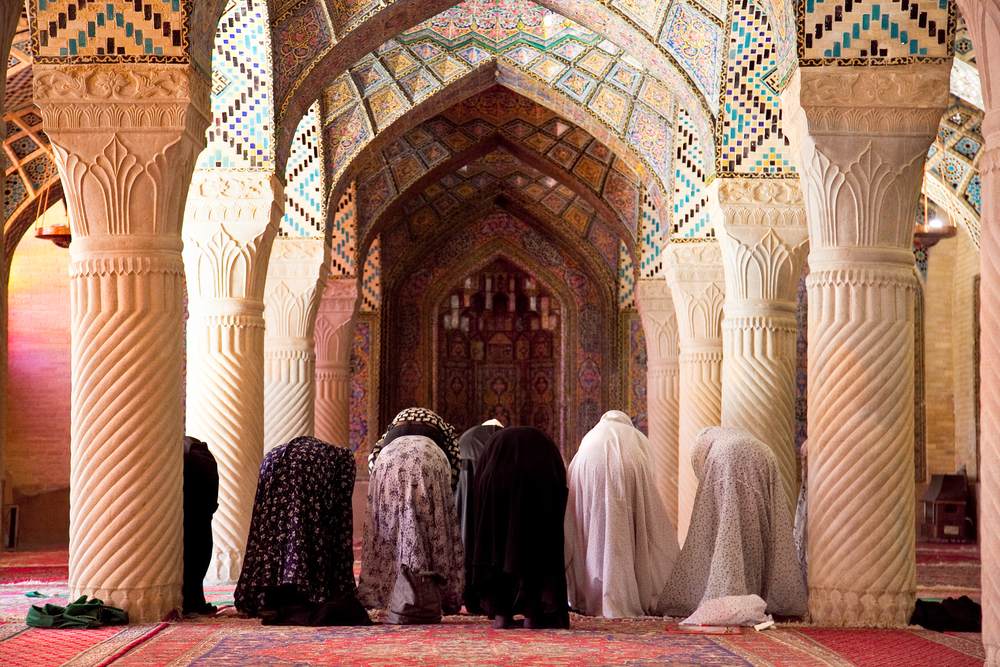 Shahadah – confession of faith. The Muslim must hold, proclaim and observe “La ilaha illa ‘llah,” that there is no god but God.
- Prayer – to be observed facing Mecca, birthplace of Muhammed, five times daily: before sunrise (fahr), noon (dhuhr), late afternoon (asr), sunset (maghrib) and before going to bed (isha). Prayer is intended for praising Allah, expressing gratitude to Allah and entreating Allah.
- Charity – (zakaat or “poor due”) – annually, each individual is to give 2.5% of all their possessions (not just income) to those in need.
- Observance of Ramadan – a month of fasting and purification observed at the time of Muhammed’s first revelation.
- Pilgrimage to Mecca – Every Muslim who is able is expected to go to Mecca to honor the birthplace of Muhammed at least once in his or her life.

The Intensity of the Qu’ran
Unfortunately, for many people in the west, their first exposure to Islam has come through news of the extreme deeds of fundamentalist Muslim terrorist organizations. Worse still, many westerners never progress to inquire into Islam beyond those first, wrong impressions.
To assume that extremist actions represent true Islam would be like judging all of Christianity based on the actions of the Klu Klux Klan. Not to inquire further into true Islam does a grave injustice to a beautiful world religion firmly rooted in spiritual Truth. Muhammed was a true prophet on the order of Abraham, Isaiah, Solomon, Moses and Jesus Christ. As we are seeing, he ranks among Moses, the Buddha, Confucius, Lao Tzu and Christ as an essential contributor to the sequence of holy teachings guiding the evolution of human consciousness.
But Islam can be difficult for western sensibilities. I have heard westerners curious enough about true Islam to pick up a copy of the Qur’an and actually read it gulp with shock at its intensity. “Have you ever read the Qu’ran?” a friend asked me once. “It’s terrifying! You either believe exactly what they say or you’re an evil infidel and you’ll go to Hell!” (Her remarks reminded me of parts of the Bible, too.)
There are actually two issues at work here: the message itself, and the tendency on earth for holy messages to become fundamentalized and thus distorted. Every religion on earth has suffered in translation from divine epiphany to scripture to interpretation and we will explore this issue together shortly.
For now, let’s just deal with the message of the Qu’ran and why it can seem so intense:
- The message is absolute, and must be absolute – that’s the point. The core message of the Qu’ran is: There is no god but God. Muhammed was right: there IS no god but God! Part of the purpose of this website is to show that the God from whom Muhammed received the revelation of the Qu’ran:
– IS Brahman of the Hindus
– IS the God of Moses
– IS Pure Being as perceived by the Buddha
– IS the Tao as perceived by Lao Tzu and Confucius
– IS the Father who manifested as Christ in Jesus.
There IS no god but God! - There is either faithfulness and obedience to God or there isn’t. You can’t have it both ways. If you lapse and apologize, you’re easily forgiven; but never at any time can you be both obedient and disobedient, faithful and unfaithful. It doesn’t work that way. Muhammed’s point was to help people become aware that, whether they know it or not, they are choosing their outcome in their daily actions. The Qu’ran declares often, essentially, “You are being warned.” The message Muhammed received was very much concerned with addressing both people’s ignorance and duplicity about God’s absolute supremacy.
- There are outcomes for the choices any individual makes. You either line up and do the work God puts before you in life, or you don’t. All religions have said this, because it’s core to the human system on earth. Jesus said, “Pick up your cross and walk.” Buddha outlined the requisite Eightfold Noble Path. Moses received the Law in the form of Ten Commandments that had to be obeyed to uphold the covenant. Throughout time, in the human expression of the sacred, there have always been ways to evolve effectively and ways to “miss the boat,” resulting in error. This error has also been expressed in lots of different ways: as “the wheel of samsara” (Hinduism); as “hell” (Abrahamic tradition – Judaism, Christianity and Islam); as “suffering” (Buddhism); as impiety (Confucius); as ignorance (“Forgive them, Father, for they know not what they do.”)
Righteous, furious indignation is characteristic of Stage 4
Of all the stages that the individual goes through on the road to conscious and embodied reunion with God, Stage 4 (Repercussions) is unquestionably the most fiery. This was the stage Moses was in when he came down from Mt. Sinai and broke the tablets in a fury, seeing the Hebrews honoring the golden calf. This was the stage Jesus Christ was in when he threw the money-changers out of the temple in a rage.
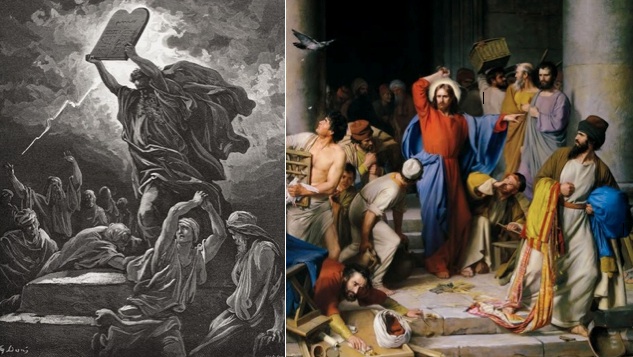
Left: Moses breaking the Tablets of the Law, Exodus by Gustave Doré (1832 – 1883). Right: Christ Cleansing the Temple by Carl Heinrich Bloch, 1875
In a future blog post, we will look at why Stage 4 can be so fiery and filled with indignation. It is a vulnerable stage of consciousness prone towards misunderstanding, distorted perception and volatility. But this vulnerability is exactly what the Prophet Muhammed’s delivery of the Qu’ran warned against.
In receiving the holy Qu’ran, Muhammed faithfully delivered from God the message of requisite surrender and purification needed to navigate these turbulent waters. The waters don’t smooth out until the end of Stage 5, when the purified soul is no longer vulnerable to distortions of perception.
The Last Prophet
 Islam holds that Muhammed is the Seal of the Prophets, the final prophet to speak for God. No prophet will come after him.
This is true. This doesn’t mean God won’t send a great, divine helper or two to usher in the few stages to come, but it does mean they won’t prophesize – i.e., they won’t say what is to be, or what is to come.
To understand this, let’s look first at what happens in the next stage – the stage of consciousness that is becoming available to us now, in our lifetimes. Then we’ll return to the important point about Muhammed being the Last Prophet.
 Level Praying Field